
African roots, a Brazilian history
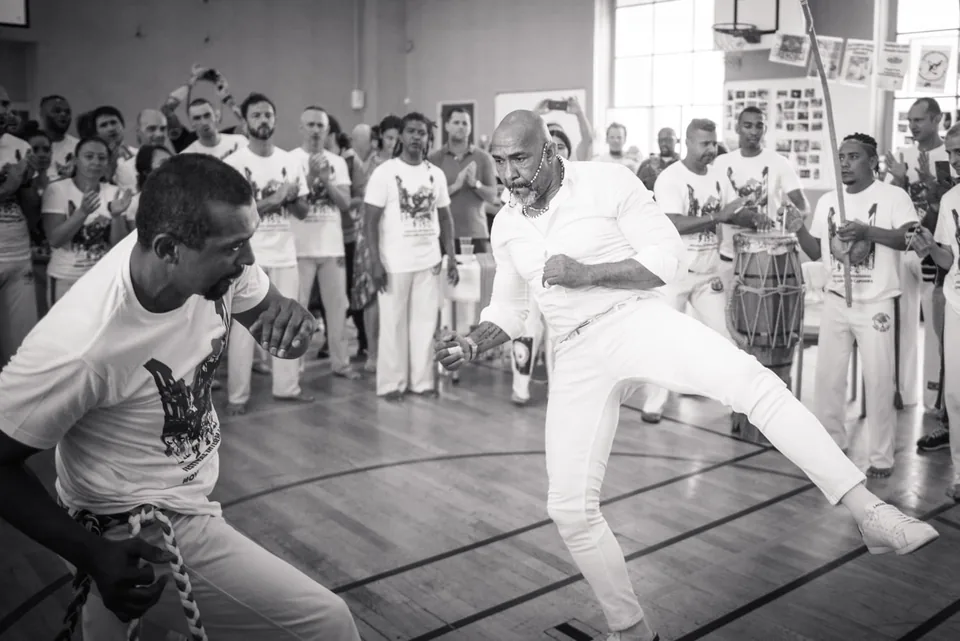
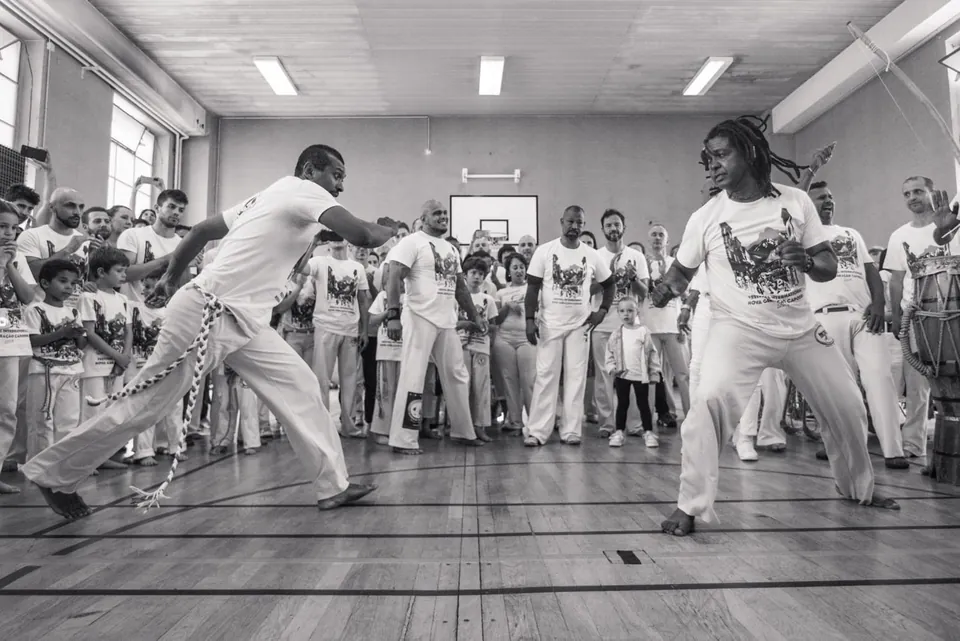
Capoeira brings together combat, play, dance, acrobatics and music. Two people hold a dialogue through movement at the centre of a roda, the circle formed by the other participants. An evasion answers an attack; a change of position invites, surprises or thwarts an intention. Songs, instruments and watchful eyes give this exchange its coherence. This Afro-Brazilian practice also carries a collective memory, passed from person to person.
Its history is bound up with the Atlantic slave trade and slavery. Between the 16th and 19th centuries, several million Africans were forcibly transported to Brazil from different regions, particularly west-central Africa. Their languages, beliefs, music and physical games met and changed within a colonial society founded on coercion. Yet capoeira cannot be given a single date of birth, nor can four centuries of practice be reconstructed as an unbroken sequence.
Engolo, a combat game from south-western Angola sometimes called the “zebra dance”, shows connections that have been studied through fieldwork. It sheds light on possible lines of transmission, without proving that a fully formed capoeira was imported intact. Stories of combat disguised as dance are part of capoeira’s memory; on their own, they cannot explain its origins. The term “Afro-Brazilian” holds together both African inheritances and forms created in Brazil.
One name, several possibilities
The word capoeira has several histories. In Brazilian Portuguese, one of its meanings is vegetation that grows back on cleared land, with an etymology traced to Tupi. It can also refer to a cage or basket for poultry. Authors have connected these meanings with places of refuge, the work of porters or markets. These linguistic hypotheses do not, by themselves, provide evidence of where the game was born.
Early documents call for the same caution: capoeira may refer to a person considered unruly as well as to a physical practice. Police records, particularly abundant in the 19th century, reveal the authorities’ perspective; they do not tell the whole story of the players’ lives. Earlier references have been identified from the late 18th century.
Other names have also been used: vadiação, brincadeira de Angola, jogo de mandinga or de São Bento. In his early 20th-century chronicles, João do Rio also records the term cungu. This vocabulary reflects the varied communities and traditions that have given capoeira its words.
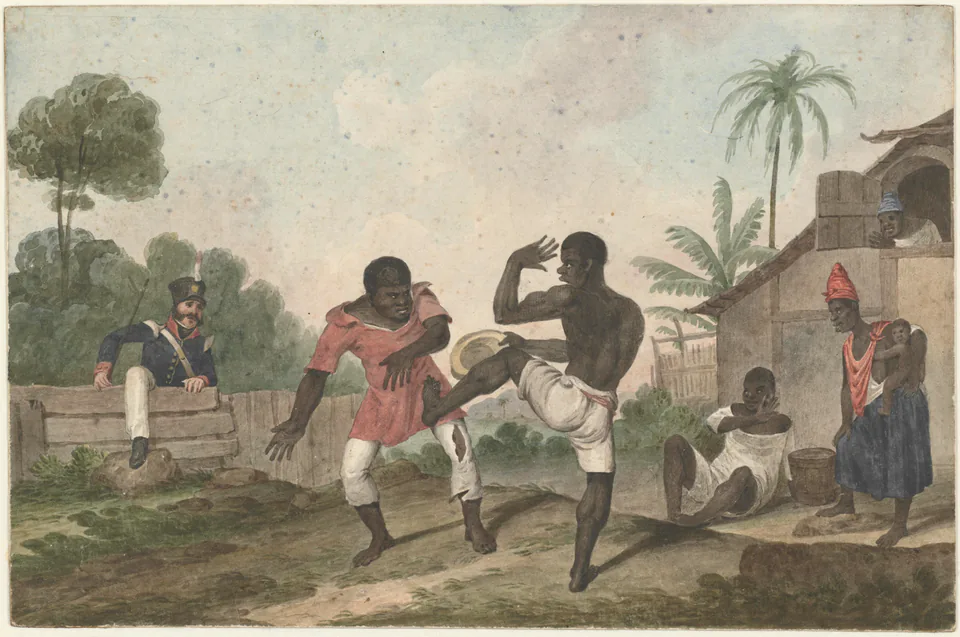
Capoeira, Brazils, around 1822. This watercolour records a travelling artist’s view of the practice in the 19th century.
Augustus Earle · National Library of Australia · Public domain ↗Sources & further reading
Resistance: from senzalas to quilombos
On plantations, senzalas were the quarters in which enslaved people were forced to live. Their lives, however, cannot be reduced to forced labour or to a single form of resistance: maintaining connections, passing on knowledge, negotiating, rebelling and fleeing were all ways of confronting domination. Quilombos welcomed fugitives among others and became communities with very different histories, sometimes connected to the economic exchanges of the surrounding area.
Palmares, established in the Nordeste, holds a central place in this memory. This network of communities resisted colonial expeditions for many years. Its main centre, Macaco, was captured in 1694; Zumbi, one of its leaders, was killed on 20 November 1695. These two events must be distinguished. The date of 20 November has become Zumbi and Black Awareness Day.
In capoeira’s songs and imagination, Palmares represents the pursuit of freedom. This symbolic significance does not, however, demonstrate that capoeira was invented there, or that its inhabitants played exactly the game we know today. Quilombos did not all disappear with abolition in 1888: quilombola communities still exist in Brazil today. The 1988 Constitution recognises land rights for the communities concerned. Their history continues beyond the heroic stories of the past.
Sources & further reading
Capoeira in the cities of the Empire
Brazil’s independence in 1822 did not end slavery. It was not legally abolished until 13 May 1888, through the Lei Áurea, after a long process of struggle. Between these two dates, port cities played a vital role in the documented history of capoeira: Rio de Janeiro, Salvador and Recife each had their own networks, practices and conflicts.
In Rio, maltas brought capoeiras together around territories and bonds of solidarity. Their clashes could be violent, and some groups maintained ties with politicians, particularly during elections. Yet reducing them to gangs of bandits would simply repeat the authorities’ language without questioning it. Players were also workers, enslaved or freed people, and later men from a range of working-class backgrounds. Capoeira accompanied festivities, social life and street rivalries.
The Paraguayan War, from 1864 to 1870, forms part of this history and of some songs. Recruitment affected people under coercion; enslaved people gained their freedom by joining the Brazilian forces. Historians have studied the presence of capoeiras among the combatants. This participation must nevertheless be distinguished from accounts of battles won thanks to capoeira: its precise military use is far less well documented than a war legend might suggest.
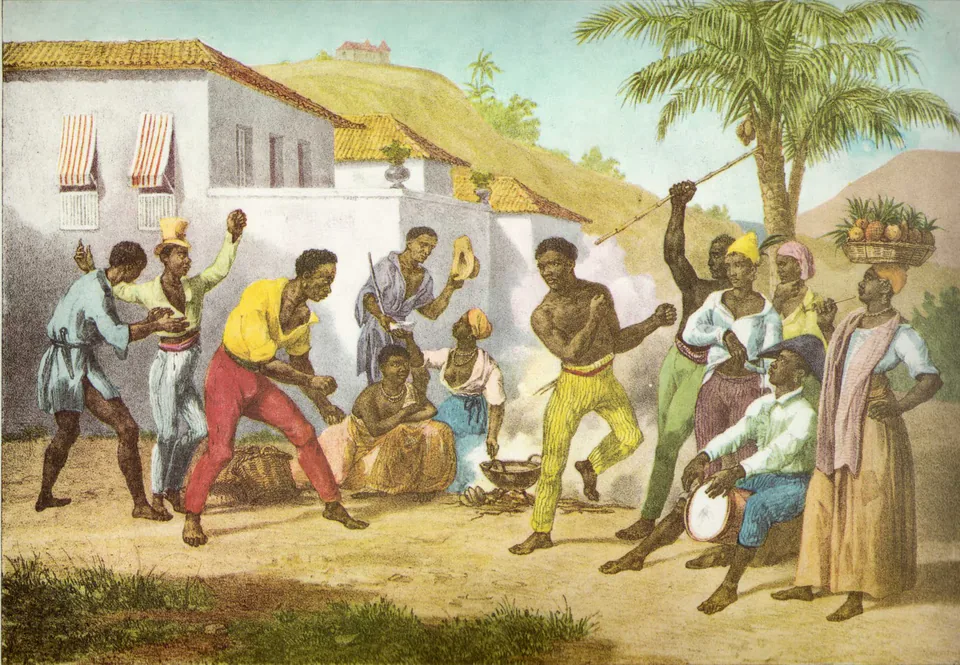
Jogar capoëra ou danse de la guerre, published in 1835. A drum is visible; the engraving does not show a berimbau.
Johann Moritz Rugendas · Public domain ↗1890: a practice criminalised
The Republic was proclaimed in 1889; explicit nationwide criminalisation of capoeiragem followed the next year. Article 402 of the Penal Code of 11 October 1890 specifically targeted the exercises known by that name in streets and public squares. It provided for two to six months in prison, with increased penalties for belonging to a malta and for its leaders. Repression had existed before this; the law gave it a particularly visible national framework.
The end of slavery therefore did not bring social equality. Black popular practices continued to be monitored and stigmatised. To keep playing and passing on their knowledge, capoeiristas adapted to places, circumstances and power relations. Apelidos, or nicknames, form part of their identities and stories: explaining them solely as a way of evading the police would be reductive.
Recognition came gradually. The licensing of Bimba’s school in 1937 was an important step. The Penal Code adopted in 1940, which came into force on 1 January 1942, no longer included the specific offence of capoeiragem. Official demonstrations, performances and its spread as a sport followed. The statement attributed to Getúlio Vargas describing capoeira as a national sport after a demonstration in the 1950s reflects this change in perception; it should not be confused with a founding law.
A living culture, diverse spiritual traditions
Capoeira developed in contact with other Afro-Brazilian forms of expression. In Bahia in particular, the same people might take part in rodas, samba and batuque, and attend candomblé terreiros. Neighbourhoods, trades, families and festivities allowed rhythms, gestures and ways of being in the world to circulate. These connections go beyond the borrowing of instruments: they also involve memory, the authority of elders and the passing on of knowledge.
Candomblé encompasses different religious traditions. Depending on the community, orixás, voduns or inquices are honoured; terreiros are religious, social and cultural spaces. Reducing this whole to a single definition would erase its diversity. Capoeira songs may evoke deities, Catholic saints, historical figures or the difficulties of everyday life.
Practising capoeira requires no religious affiliation. It is nevertheless possible to learn to recognise and respect the references in its songs and rituals. Understanding them enriches the game and helps avoid treating this inheritance as mere exotic decoration. Welcoming everyone can go hand in hand with care for the culture passed on to us.
The berimbau, songs and the pace of the game
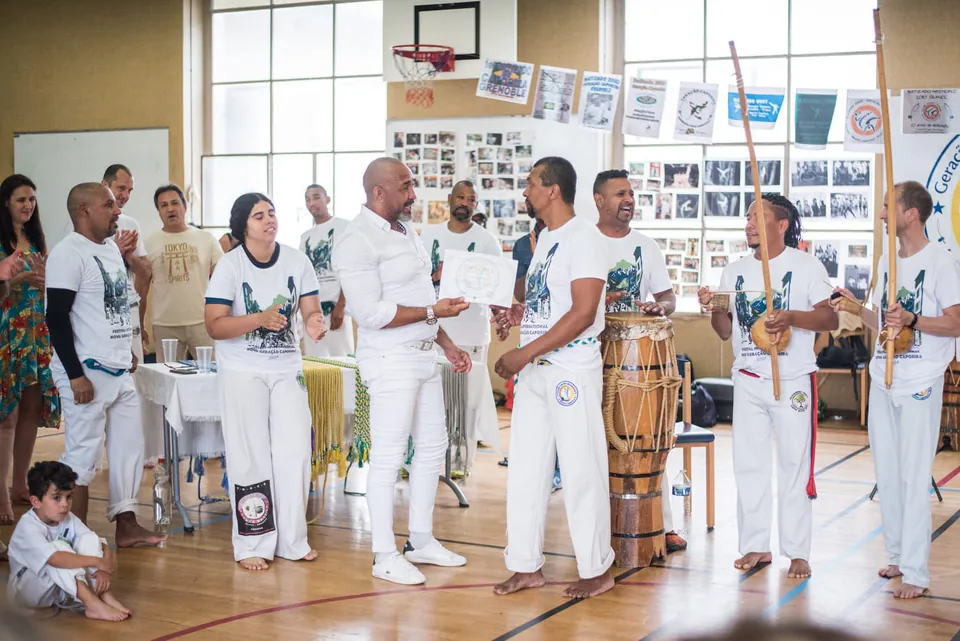
Music organises the roda. The berimbau, a single-string musical bow with a gourd resonator, gives cues for rhythm and play; the pandeiro, a frame drum, the atabaque, a barrel-shaped drum, the agogô, a bell, and the reco-reco, a scraped instrument, may complete the ensemble. Its composition depends on the school. Clapping and the chorus’s responses make the people surrounding the players full participants in the roda.
These instruments have histories that predate their coming together in capoeira. Images from the 19th century show drum accompaniment; musical bows also circulated in Brazil. There was no general switch in 1888 from a drum to more portable instruments. The berimbau gradually became central to capoeira in Bahia, before establishing its place as capoeira spread.
Toques are rhythmic patterns associated with ways of playing and moments in the roda. Tradition tells us that Cavalaria warned of the arrival of mounted police. Songs, meanwhile, tell stories, greet people, comment or give warnings. Ladainhas, chulas, quadras and corridos follow different structures depending on the lineage. Learning to hear the intention in the music, join in a chorus and understand its words is therefore as much a part of training as learning the movements.
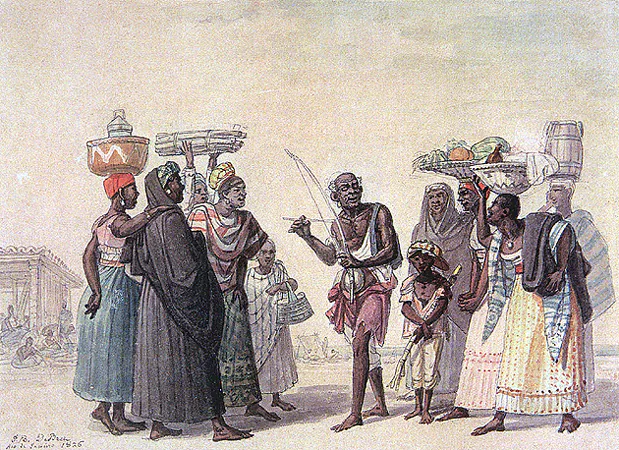
Le vieil Orphée africain (Oricongo), 1826. Evidence of the musical bow’s presence in Brazil, although the scene is not a capoeira roda.
Jean-Baptiste Debret · Museus Castro Maya · Public domain ↗Mestre Bimba and Capoeira Regional
Manoel dos Reis Machado, Mestre Bimba (1899–1974), played a decisive role in transforming teaching in Salvador. His school opened in 1932 and received an official licence in 1937. He developed Luta Regional Baiana, which became Capoeira Regional, with the aim of strengthening the game’s combat effectiveness and securing it a recognised place in society.
His teaching method structured students’ progress through eight learning sequences, work in pairs, rules of conduct, the batizado and stages of training. Batuque, a form of wrestling practised by his father among others, is one of the influences cited. Exchanges with other combat sports were part of the context of his time, but presenting his method as a simple combination of boxing, jiu-jitsu and Asian martial arts would be too schematic. Bimba transformed a tradition he knew from within.
In Bimba’s Regional, the ensemble consists of one berimbau and two pandeiros. Its repertoire includes São Bento Grande da Regional, Banguela, Cavalaria, Santa Maria, Iúna, Idalina and Amazonas. The name Benguela, widely used in present-day practice, needs to be distinguished according to how it has been passed on and used. These names do not denote a single speed: each toque belongs to a set of playing conventions. Regional thus retains a musical, ritual and collective dimension, even when emphasising its martial demands.
Mestre Pastinha and Capoeira Angola
Vicente Ferreira Pastinha, Mestre Pastinha (1889–1981), became a major reference point for Capoeira Angola. From 1941, he led the Centro Esportivo de Capoeira Angola in Salvador. The centre’s history is a collective one: other masters, including Amorzinho and Noronha, took part. Pastinha passed on, organised and defended this inheritance; he did not create all Angola traditions single-handedly.
His teaching placed great importance on malícia, the intelligence that observes, feints, waits and surprises, as well as on rituals, music and the relationship between players. Ground play, calls and theatricality have an important place in it. But Angola cannot be reduced to slow capoeira or the imitation of animals: it can be lively, demanding and combative. Its masters, too, have developed their methods and institutions over time.
Many Angola rodas today bring together three berimbaus — gunga, médio and viola — two pandeiros, an atabaque, an agogô and a reco-reco. Angola, São Bento Pequeno and São Bento Grande de Angola are among the well-known toques. Ensembles and conventions vary with lineages and periods. The atabaque appears in images that long predate Pastinha: its introduction cannot simply be attributed to him. His writings and elders’ testimonies instead reveal a rich and nuanced philosophy of the game.
Sources & further reading
A diverse capoeira, open to the world
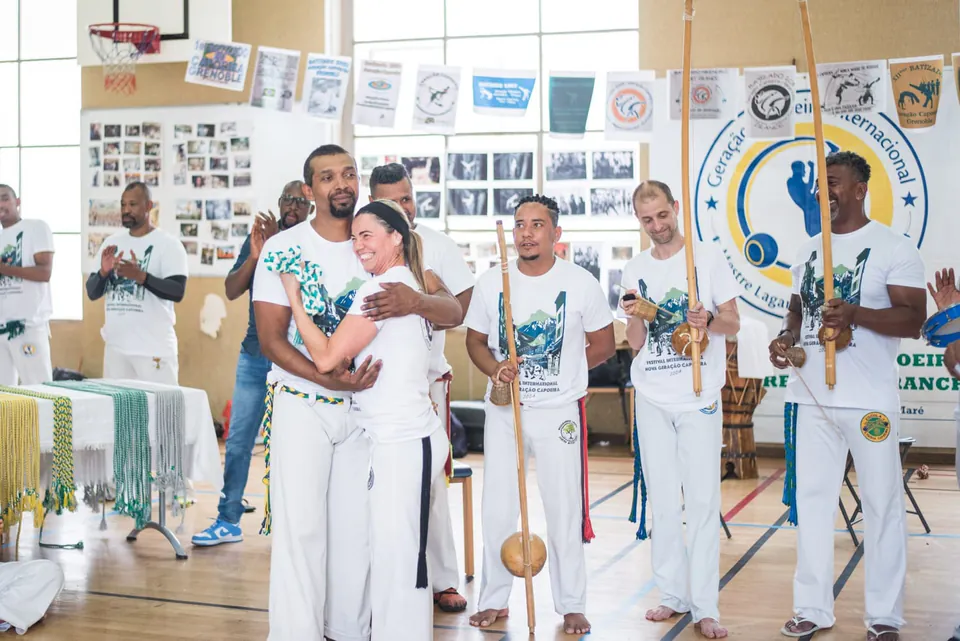
After the mid-20th century, masters’ travels, academies, performances and gatherings opened up new routes of exchange. Rio de Janeiro and São Paulo in particular became places of experimentation and dissemination. Organised groups formed and then opened schools abroad. The paths of Senzala, Muzenza, Abadá, Capoeira Brasil, Herança Cultural and Nova Geração illustrate the variety of names found across this landscape.
The term “contemporary capoeira” covers different practices and teaching choices. Some groups combine elements of several traditions; others uphold a more specific lineage. Angola, Regional and contemporary forms are not three completely separate categories. Understanding a school means listening to its masters, rhythms and references, and observing how it builds its roda.
In 2008, Brazil recognised the roda and the work of capoeira masters as cultural heritage. In 2014, UNESCO inscribed the capoeira circle on the Representative List of the Intangible Cultural Heritage of Humanity. This recognition concerns a living practice and its transmission. Continuing this history means learning the movements, singing, listening to elders and caring for the circle we share.